VAP DIGITAL BOOKSHELF - TIMPANI
VAP Digital Bookshelf: Premium Digital Archives
Every VAP Digital Bookshelf edition represents the highest standard in digital preservation. Our books are meticulously scanned at 600 DPI resolution, ensuring crisp, detailed reproductions that capture every nuance of the original text.
Advanced Digital Processing: Each page undergoes professional enhancement through our comprehensive digitization process:
Authentic Digital Experience: By maintaining original layouts, typography, and formatting, VAP Digital Bookshelf editions provide scholars, researchers, and enthusiasts with the most faithful digital reproductions available.
For complete specifications and purchasing information, click "Learn More & Purchase."
Every VAP Digital Bookshelf edition represents the highest standard in digital preservation. Our books are meticulously scanned at 600 DPI resolution, ensuring crisp, detailed reproductions that capture every nuance of the original text.
Advanced Digital Processing: Each page undergoes professional enhancement through our comprehensive digitization process:
- *Precision straightening to correct any scanning irregularities
- *State-of-the-art OCR technology that makes entire texts fully searchable
- *Native language optimization - German texts remain searchable in German, Italian texts in Italian, preserving linguistic authenticity
- *Original formatting preservation to maintain the authentic reading experience
Authentic Digital Experience: By maintaining original layouts, typography, and formatting, VAP Digital Bookshelf editions provide scholars, researchers, and enthusiasts with the most faithful digital reproductions available.
For complete specifications and purchasing information, click "Learn More & Purchase."
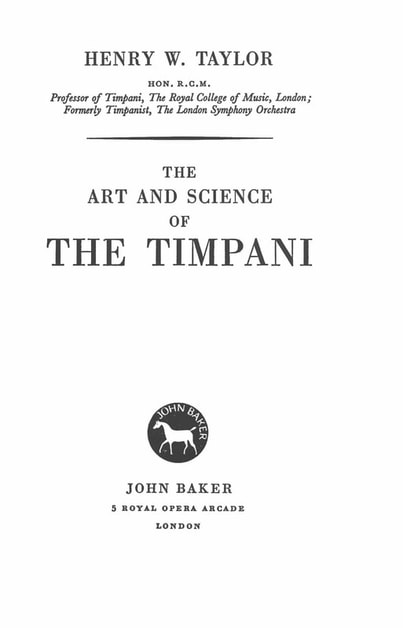
HENRY TAYLOR
THE ART AND SCIENCE OF TIMPANI
The book was originally published in 1964 by Henry W. Taylor, and was out of print for 50 years before being made available again through VAP Media's Digital Bookshelf.
This is a foundational text that bridges the gap between practical timpani performance and the scientific understanding of how the instrument produces sound, making it valuable for both performers and instrument makers.
JOSEPH ZETTELMAN
INSTRUCTOR FOR LUDWIG PEDAL TYMPANI
In 1920, Ludwig and Ludwig published a groundbreaking collection compiled by Zettleman. The book features 35 progressive etudes for pedal timpani and 55 orchestral excerpts drawn from contemporary symphonic and operatic works.
These etudes were among the first to emphasize melodic phrasing and served as early examples of timpani pedagogy. They focused on developing a timpanist’s musical ear and mastery of pitch changes while playing.
FRANZ KRUGER
PAUKEN-UND KLEINE TROMMEL-SCHULE
This extraordinarily rare method book represents the pedagogical legacy of one of Berlin's most influential percussion educators. Franz Krüger's comprehensive approach to timpani and snare drum instruction—along with exercises for xylophone and orchestra bells—captures the methods that shaped an entire generation of German percussionists.
This method book thus represents more than instructional material—it stands as a loving memorial to a master teacher, preserving techniques that might otherwise have been lost to history.
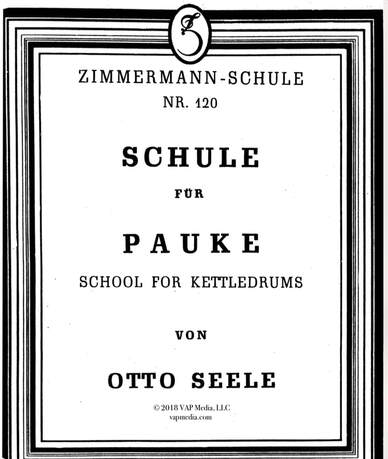
OTTO SEELE
SCHULE FÜR PAUKE
SCHULE FÜR PAUKE
Otto Seele's "Schule für Pauke" (originally published in 1897) is a foundational timpani method book. Otto Seele was a percussionist and timpanist with the Theater and Gewandhaus Orchestra in Leipzig.
The book serves as a comprehensive instructional method for timpani. His groundbreaking timpani method has been historically significant in timpani pedagogy and is still referenced today.
The book continues to be used by timpani students and teachers as part of comprehensive timpani education, alongside other established methods in the percussion repertoire.
The book serves as a comprehensive instructional method for timpani. His groundbreaking timpani method has been historically significant in timpani pedagogy and is still referenced today.
The book continues to be used by timpani students and teachers as part of comprehensive timpani education, alongside other established methods in the percussion repertoire.
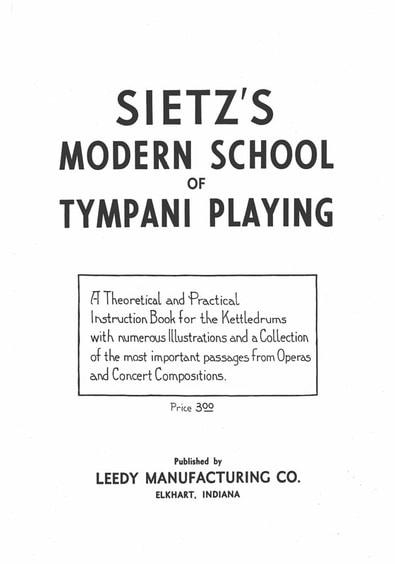
FRED SIETZ
MODERN SCHOOL
FOR TIMPANI
MODERN SCHOOL
FOR TIMPANI
The Modern School carries the descriptive subtitle: "a theoretical and practical instruction book for the kettledrums with numerous illustrations and a collection of the most important passages from operas and concert compositions." This ambitious scope reflects the book's dual purpose as both pedagogical method and historical reference.
The Modern School stands as a foundational text in timpani pedagogy, serving as the direct predecessor and primary model for Saul Goodman's later acclaimed method book. This lineage demonstrates the work's enduring influence on timpani education and its role in establishing the pedagogical standards that continue to shape timpani instruction today.
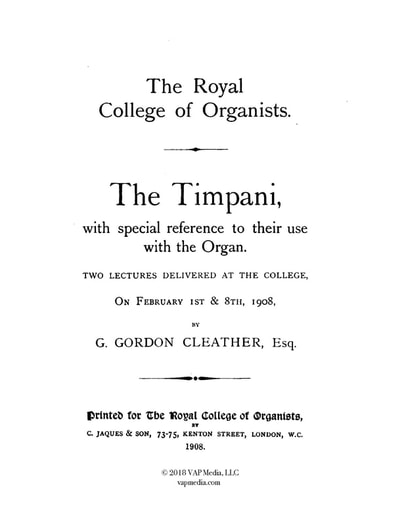
GORDON CLEATHER
THE TIMPANI
THE TIMPANI
G. Gordon Cleather presented two lectures to the Royal College of Organists in 1908 which are now titled "The Timpani". The titles are "The Timpani: With Special Reference to Their Use with the Organ”, along with “Music in Rhythm-As Exemplified by the Timpani”.
These two lectures serve as "little time machines into the performance practices of timpanists at the turn of the 20th Century." Cleather stated at the outset that his topics would include the "rhythmical [sic.] side of the instrument, the artistic side, the construction, and the need to establish a recognized school and standard of Timpani-playing".
These lectures represent an attempt to systematize and standardize timpani instruction at a time when the instrument was still developing its modern identity in the orchestra.
The work is particularly valuable for understanding the transition period in timpani playing technique and the evolving standards of performance practice during the early 20th century.
These two lectures serve as "little time machines into the performance practices of timpanists at the turn of the 20th Century." Cleather stated at the outset that his topics would include the "rhythmical [sic.] side of the instrument, the artistic side, the construction, and the need to establish a recognized school and standard of Timpani-playing".
These lectures represent an attempt to systematize and standardize timpani instruction at a time when the instrument was still developing its modern identity in the orchestra.
The work is particularly valuable for understanding the transition period in timpani playing technique and the evolving standards of performance practice during the early 20th century.
ERNEST PFUNDT
DIE PAUKEN
DIE PAUKEN
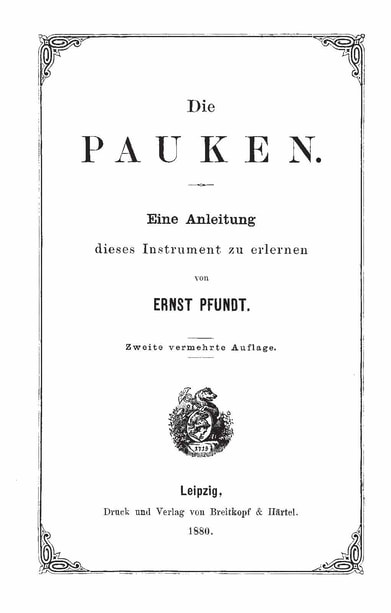
"Die Pauken" by Ernst Pfundt was originally published in 1849, with a second edition appearing in 1880. The full title is "Die Pauken: eine Anleitung dieses Instrument zu erlernen" (The Timpani: An Instruction for Learning This Instrument). The book is considered to be one of the most important historical documents on the instrument.
"Die Pauken" represents a pivotal moment in timpani pedagogy and history. It comes from an era when the timpani was undergoing significant technical development, and Pfundt's dual role as both performer and instrument designer gives his instructional work unique authority. The book stands as both a method book and a historical document that captures mid-19th century timpani performance practices and technical knowledge from someone who was actively shaping the instrument's evolution.
This work is particularly valuable for understanding the transition from earlier timpani designs to more modern instruments, as Pfundt was directly involved in the mechanical improvements that would influence timpani construction for generations to come.
"Die Pauken" represents a pivotal moment in timpani pedagogy and history. It comes from an era when the timpani was undergoing significant technical development, and Pfundt's dual role as both performer and instrument designer gives his instructional work unique authority. The book stands as both a method book and a historical document that captures mid-19th century timpani performance practices and technical knowledge from someone who was actively shaping the instrument's evolution.
This work is particularly valuable for understanding the transition from earlier timpani designs to more modern instruments, as Pfundt was directly involved in the mechanical improvements that would influence timpani construction for generations to come.
CARLO ÁNTONIO BORACCHI
MANUALE PEL TIMPANISTA
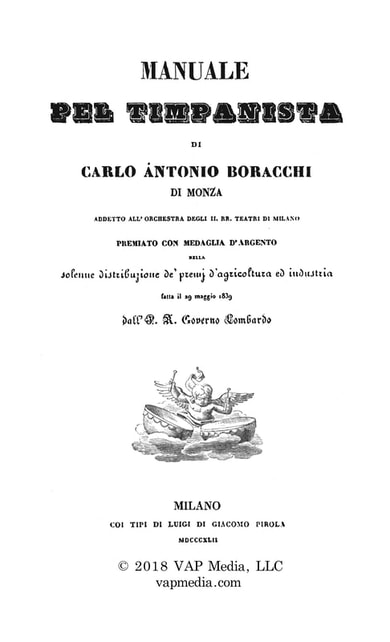
Boracchi's Manuale Pel Timpanista was originally published in 1842 and is one of the earliest books covering timpani. This makes it a historically important document for understanding 19th-century timpani performance and construction.
This manual represents an important primary source for understanding timpani technique, construction, and performance practices in mid-19th century Italy, particularly at one of the world's most prestigious opera houses, La Scala.
Given Boracchi's practical experience both as a performer and instrument maker, the work contains valuable insights into both the artistic and technical aspects of timpani playing from that era.
This manual represents an important primary source for understanding timpani technique, construction, and performance practices in mid-19th century Italy, particularly at one of the world's most prestigious opera houses, La Scala.
Given Boracchi's practical experience both as a performer and instrument maker, the work contains valuable insights into both the artistic and technical aspects of timpani playing from that era.